Stop Practising Blindly
Discover why repeated practice does not always produce a higher score and learn to use the correction cycle:
Write → Diagnose → Correct → Drill → Retest
For IELTS Writing candidates stuck at Band 6 or 6.5
Discover what is really holding your score back—and follow a practical system designed to help you work towards Band 7.
You have written essay after essay.
You have watched countless IELTS videos, memorised linking words and collected enough “Band 9 vocabulary” to frighten a dictionary.
Yet your Writing score still says:
6.5
If that sounds familiar, the problem may not be how hard you are working.
The problem may be that you are practising without knowing exactly what needs to be fixed.
Immediate digital access • Practical worksheets • 14-day implementation plan
Secure payment options

Band 6.5 can be one of the most frustrating IELTS scores.
You are clearly not a beginner. You can understand the question, organise paragraphs and communicate your ideas. However, something keeps preventing your writing from reaching Band 7.
The trouble is that your final score does not tell you exactly what went wrong.
Was your position unclear?
Were your ideas relevant but underdeveloped?
Did your paragraphs lack progression?
Was your vocabulary ambitious but inaccurate?
Were repeated grammar errors limiting an otherwise strong response?
Without a proper diagnosis, you are forced to guess.
So you write another essay, learn another list of phrases and hope that more practice will eventually produce a different result.
But practice without correction often strengthens the same habits that created the problem.
Writing ten more Band 6.5 essays does not automatically create a Band 7 writer. It may simply create a faster Band 6.5 writer.
Remaining stuck at Band 6.5 can mean:
Paying another IELTS test fee
Delaying a university application
Missing a migration or employment opportunity
Spending more money on courses and materials
Losing confidence whenever you sit down to write
Wondering whether Band 7 is even realistic for you
The hardest part is often not the result itself.
It is not knowing why the result keeps happening.
You may spend hours fixing vocabulary when Task Response is the real problem. You may write complicated sentences to demonstrate range while creating more grammar errors. You may memorise an impressive introduction that does not properly answer the question.
You are working harder, but the work is aimed at the wrong target.
On test day, the pressure becomes even worse. You overthink the question, spend too long on Task 1 and rush through Task 2.
Then the result arrives:
Test report form
WRITING: 6.5
Again.
You do not need more random advice.
You need to identify the specific scoring pattern keeping you stuck—and follow a focused correction plan.
Diagnose • Correct • Retest
The Diagnostic Shortcut for the Stuck IELTS Writing Student
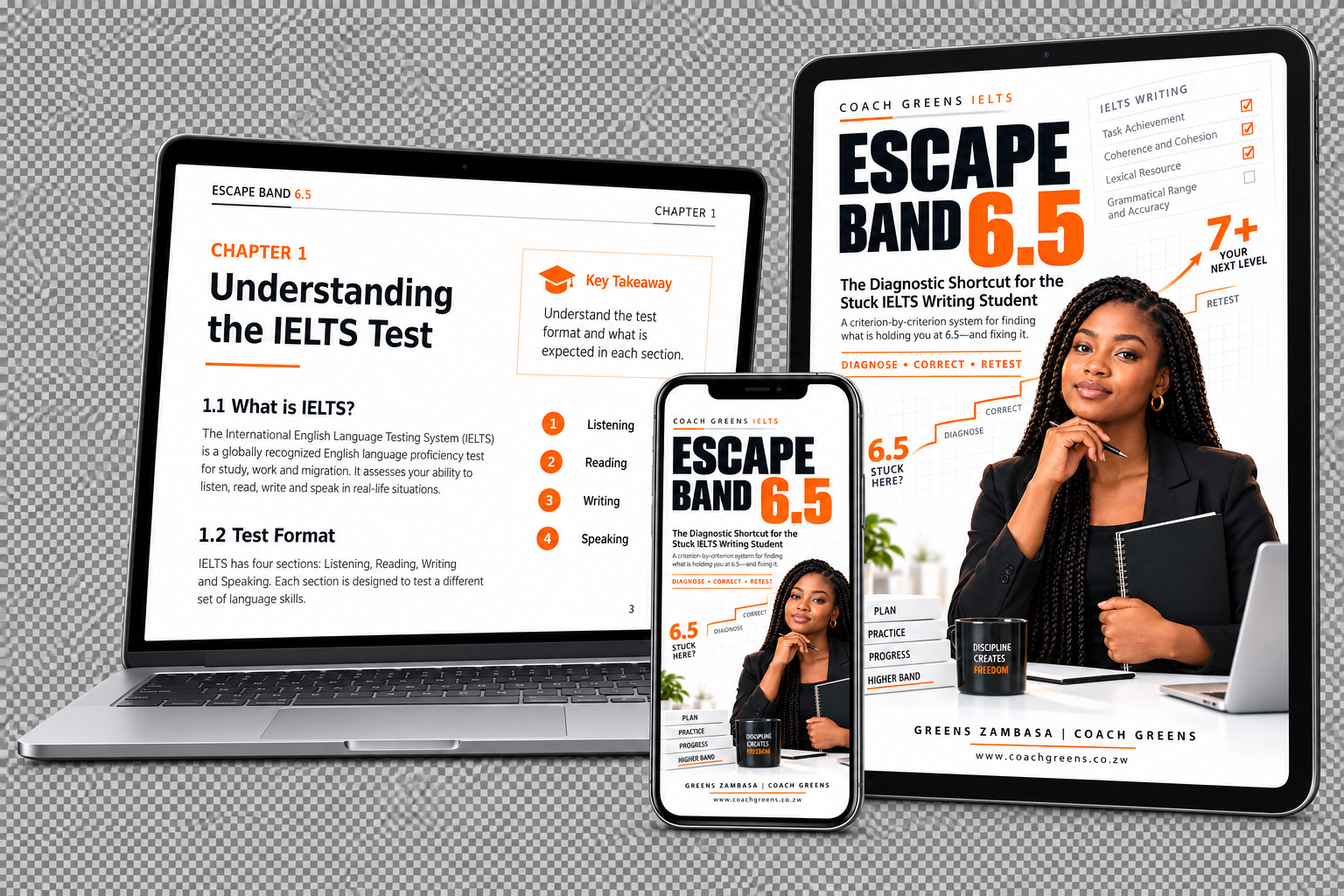
Escape Band 6.5 is a practical IELTS Writing guide that helps you stop practising blindly.
Instead of giving you another collection of memorised templates and complicated vocabulary, it shows you how to:
Diagnose the criterion limiting your score
Correct the repeated mistakes causing the damage
Retest your writing to determine whether the correction works under timed conditions
The system covers all four IELTS Writing assessment areas:
You will learn how to turn examiner criteria into clear actions you can apply to your own writing.
No vague advice.
No magical Band 9 phrases.
No promise that using “Moreover” three times will transform your life.
Just practical diagnosis, guided correction and measurable improvement.
What you will learn
Discover why repeated practice does not always produce a higher score and learn to use the correction cycle:
Write → Diagnose → Correct → Drill → Retest
Evaluate your writing through four assessment lenses and identify the criterion causing the greatest damage.
Use the Claim–Why–How–Result system to develop ideas instead of repeating the same point in different words.
Build paragraphs that guide the examiner logically from one sentence to the next without filling the page with unnecessary linking words.
Apply the Safe–Stretch–Gamble Risk Ladder to choose language that demonstrates ability without sounding memorised or unnatural.
Find your Error Fingerprint, correct repeated mistakes and rebuild stronger sentences.
Use practical rescue systems for panic, poor timing, unfamiliar questions, weak ideas and unfinished responses.
Combine the complete system using quick-reference planning, writing and checking tools.
What's included
This is more than an e-book to read once. It is a practical toolkit you can use during preparation.
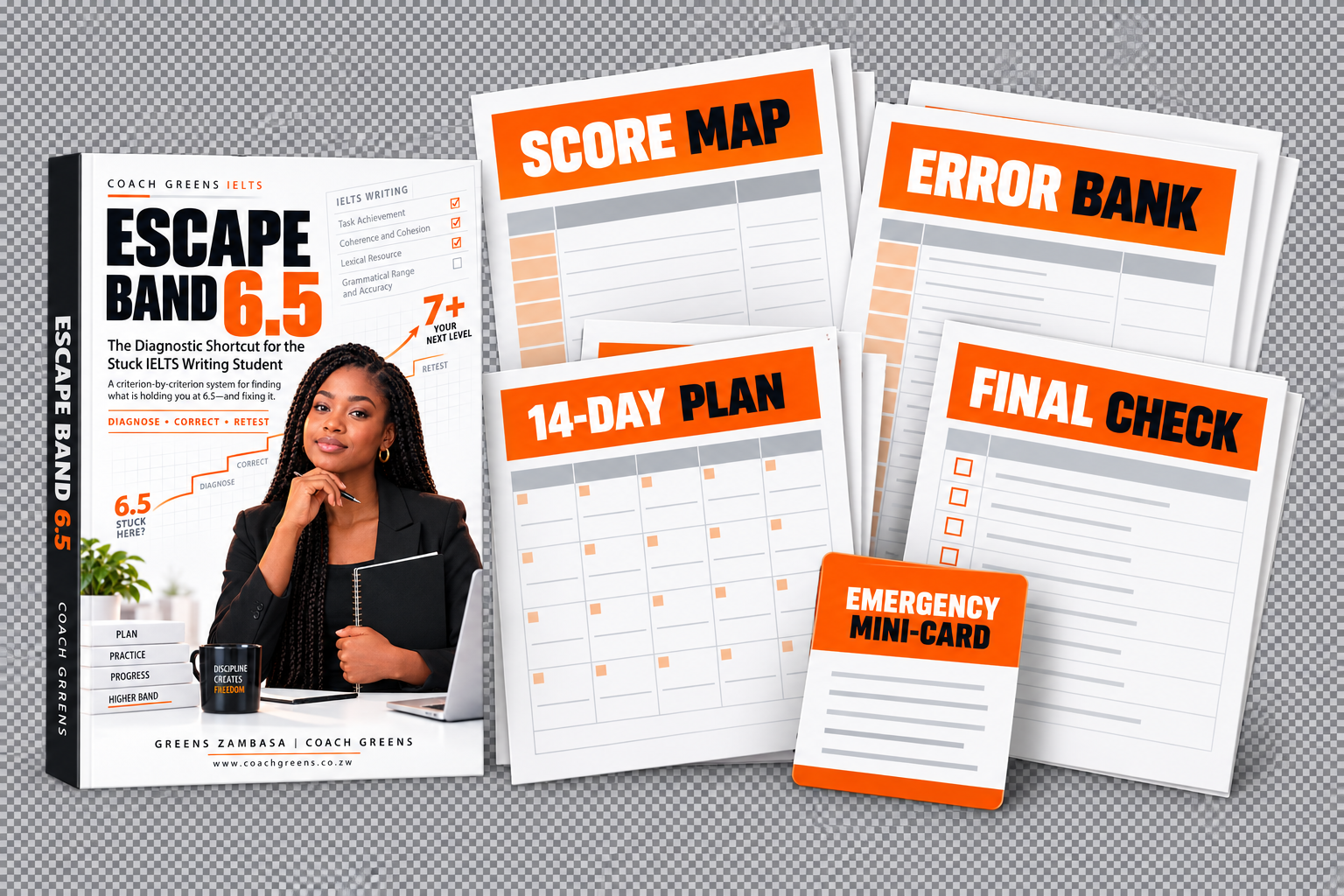
These tools help you move from reading about improvement to correcting your own writing.
Because understanding a technique is useful.
Using it under timed conditions is considerably more useful.
Each chapter contains:
You are not expected to finish the book, nod thoughtfully and place it in a folder called “IELTS Materials.”
You are expected to use it.
— Coach Greens
This is a practical system. It works best when you complete the exercises honestly and apply the corrections under timed conditions.
You should be able to identify:
Instead of asking, “How can I improve my writing?” you can identify one priority and work on it deliberately.
14-day implementation plan
The included implementation plan helps you turn diagnosis into deliberate daily practice.
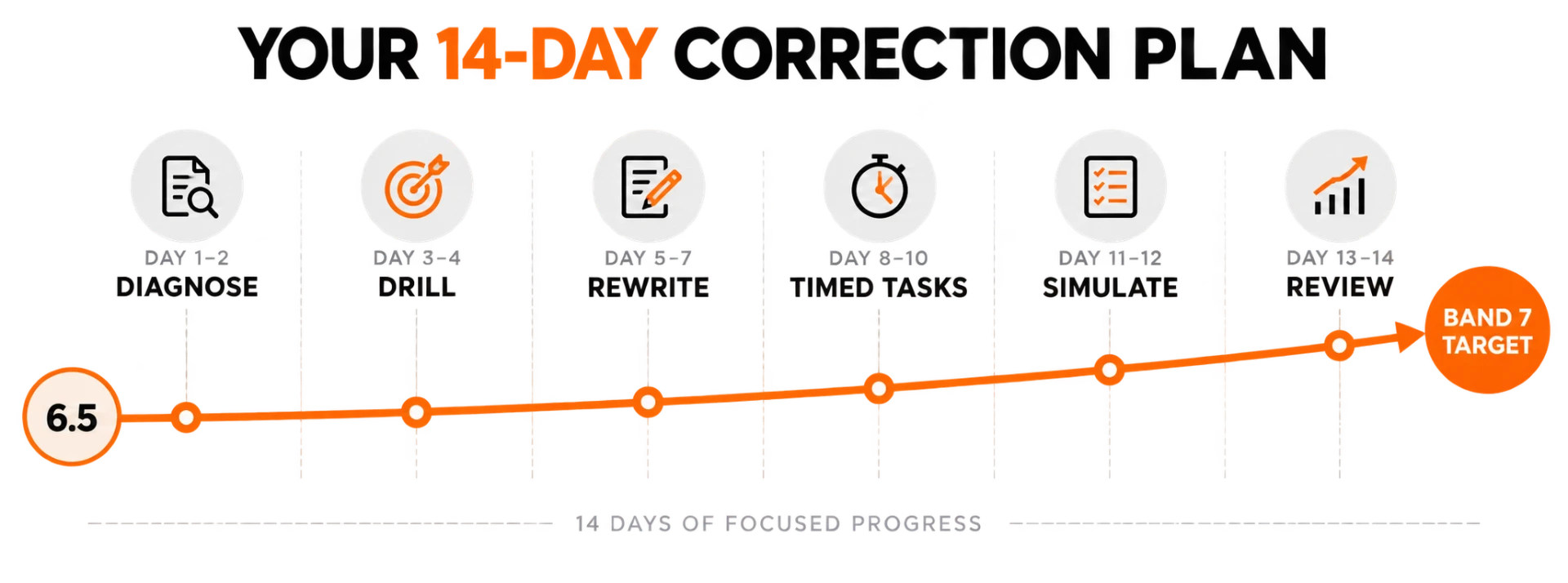
Days 1–3
Diagnose your primary weakness
Days 4–6
Complete criterion-specific drills
Days 7–9
Rewrite weak paragraphs
Days 10–11
Complete timed individual tasks
Day 12
Review your Error Bank
Day 13
Complete a full Writing simulation
Day 14
Analyse your progress and choose your next priority
The goal is not to make you feel busy.
The goal is to make every practice session serve a clear purpose.

Greens Zambasa, known as Coach Greens, is an experienced English tutor specialising in IELTS and PTE preparation. He understands both the demands of the test and the pressure candidates face. Through practical lessons, guided practice and honest feedback, he has helped more than 2,000 students prepare for international study, migration and career opportunities. His teaching focuses on clear strategies, accurate diagnosis and steady improvement rather than memorised tricks. In Escape Band 6.5, he brings that same direct, supportive approach to students who are working hard but need a smarter path to Band 7.
Experienced IELTS and PTE tutor • More than 2,000 students supported • Practical strategy and guided correction
No ethical IELTS tutor can guarantee your result.
Your final score depends on your current English level, the quality of your practice, your performance on test day and how consistently you apply what you learn.
What this book gives you is a structured method for identifying weaknesses, correcting recurring problems and preparing with greater purpose.
It replaces guesswork with a plan.
FAQ
It is primarily designed for candidates scoring Band 6 or 6.5 in IELTS Writing, particularly those working towards Band 7.
Yes. The core scoring and correction systems apply to both versions. The toolkit also includes separate completion checks for Academic Task 1 and General Training Task 1.
It includes failure and successful revision examples so that you can see exactly how writing is improved. Its main purpose is to help you diagnose and correct your own work.
No. No responsible tutor can guarantee an IELTS score. The book gives you a structured preparation system, but your result depends on your English ability, practice and test-day performance.
Yes. The e-book is delivered digitally and can be read on a phone, tablet or computer.
Yes. The diagnostic exercises, worksheets and checklists can be printed or completed digitally.
You will receive digital access after completing your purchase.
You may not need another month of random essay writing.
You may need to identify the repeated weakness controlling your score.
Escape Band 6.5 helps you find that weakness, understand it and create a focused plan to correct it.
Your score will not change because you hope harder.
It changes when your writing changes.
Diagnose. Correct. Retest.
Secure payment options
Start preparing with greater clarity today.